
Death Valley's Sailing Stones Move Across the Desert Floor, and Thin Ice Does the Pushing
Rocks on the Racetrack Playa leave grooves hundreds of meters long, and for decades nobody had seen one move. In December 2013, GPS units and cameras finally caught it: sheets of ice a few millimeters thick, pushed by a light wind.
Key points
- On December 20, 2013, more than 60 rocks moved at the same time on a dry lake bed in Death Valley, and nobody had to guess how.
- The place is the Racetrack Playa, a flat dry lake in Death Valley National Park, California.
- In 2011, cousins Richard Norris, a scientist at the Scripps Institution of Oceanography, and James Norris set up a quiet watch.
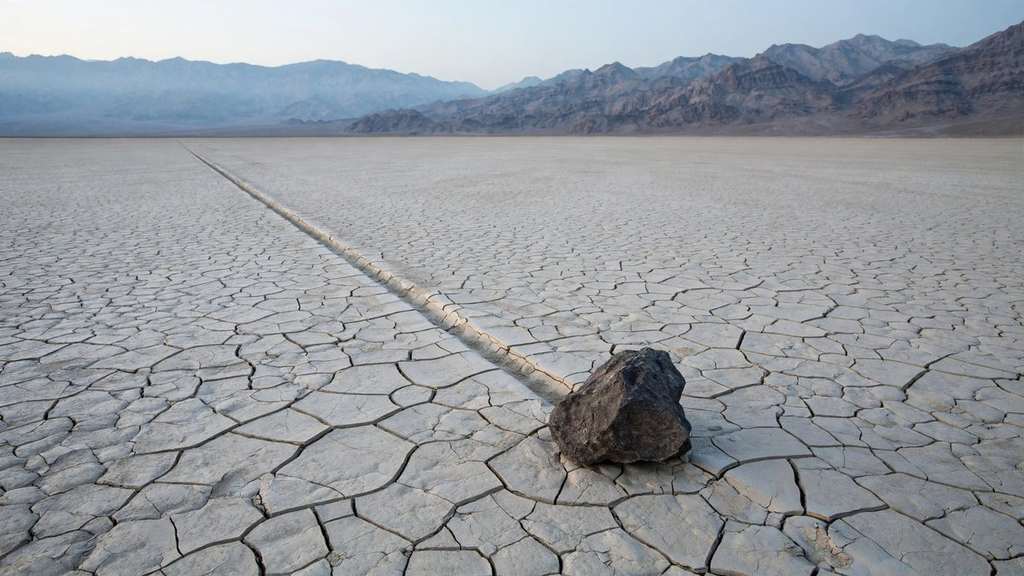
On December 20, 2013, more than 60 rocks moved at the same time on a dry lake bed in Death Valley, and nobody had to guess how. Instruments recorded the event. The rocks slid at 2 to 5 meters a minute, pushed by floating panels of ice so thin that earlier researchers had ruled ice out as the cause.
The place is the Racetrack Playa, a flat dry lake in Death Valley National Park, California. Hundreds of rocks sit there with long grooves cut into the mud behind them, some tracks stretching for hundreds of meters. A few of the stones weigh as much as 320 kilograms. Reports of the moving rocks reached print in 1948, and the guessing ran for more than 60 years. Proposed causes included hurricane force winds, dust devils, slick films of algae, and thick ice rafts that lifted the stones and carried them.
The experiment that caught them
In 2011, cousins Richard Norris, a scientist at the Scripps Institution of Oceanography, and James Norris set up a quiet watch. With permission from the park, they placed 15 rocks fitted with motion activated GPS units on the playa. The rocks came from outside, because the park would not let them use native stones. A weather station recorded wind gusts every second, and time lapse cameras kept watch through the winter. The wait lasted two winters.
In late November 2013, rain and snow filled the south end of the playa with a shallow pond, about 10 centimeters deep at most. The team documented five movement events in the two and a half months the pond lasted. On December 4, two instrumented rocks, one of 16.6 kilograms and one of 8.2 kilograms, started moving within six seconds of each other, about 153 meters apart. Each slid about 65 meters in 16 minutes. On December 20, more than 60 rocks moved in the largest event recorded. Across December and January, some instrumented rocks covered up to 224 meters in several separate moves.
Ice a few millimeters thick
The recipe needs a cold night and a shallow pond. At night the water freezes into sheets of ice 3 to 6 millimeters thick. Late morning sun breaks the sheets into floating panels tens of meters wide. A light wind, about 4 to 5 meters per second, pushes the panels across the water. A panel piles up against a rock and shoves it forward. The rock slides through the soft mud instead of rolling, and it cuts the groove that puzzled people for decades. When the water drains away and the mud dries, the track stays.
The motion is easy to miss. Two to five meters a minute is only a few inches a second, under water and ice, on a lake bed that is dry 99 percent of the time. Tracks can sit for more than a decade before the next pond forms. One honest limit remains. The team watched small and medium rocks move. The largest stones on the playa, the 320 kilogram ones, have not been seen moving, and whether the same thin ice can push them is still an open question.
The mystery lasted because the cause was so small. No storm, no flood. Just a skin of ice, a light wind, and time.