
Why Chocolate Melts in Your Mouth and Not in Your Hand
Cocoa butter can set into six crystal forms. The one chocolatiers chase, Form V, melts at 33.8 degrees Celsius, just below body temperature.
Key points
- Chocolate is one of the few foods engineered by nature to melt at exactly the temperature of your mouth.
- A cocoa bean is roughly half nib and half cocoa butter, as Smithsonian Magazine explains in its science of chocolate account.
- Cocoa butter is unusual because the same fat can set into six different crystal forms.
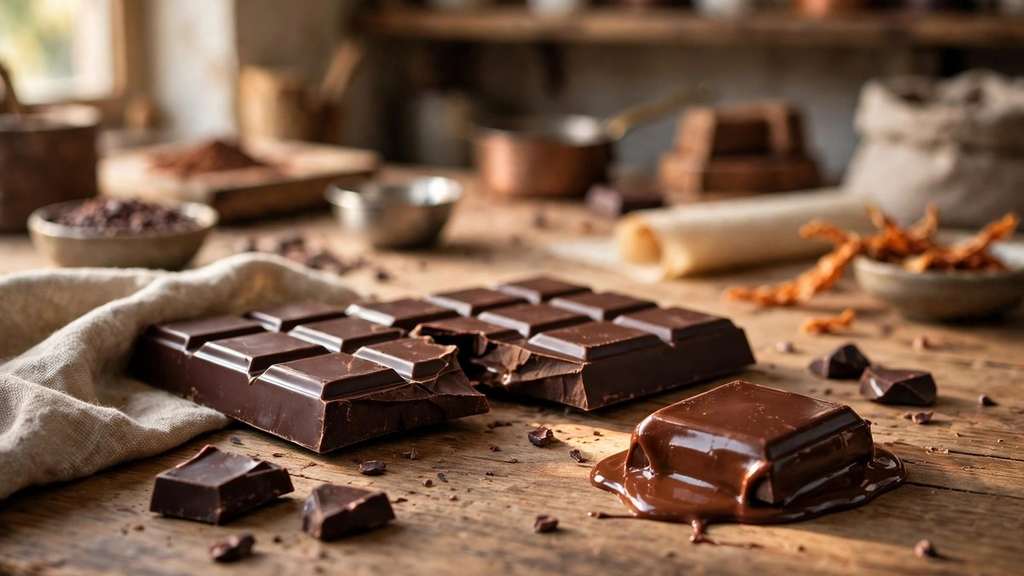
Chocolate is one of the few foods engineered by nature to melt at exactly the temperature of your mouth. A good bar is hard in the hand, snaps when you break it, and turns to liquid seconds after it lands on your tongue. That timing is not luck. It is one fat, cocoa butter, and the crystals it forms.
A cocoa bean is roughly half nib and half cocoa butter, as Smithsonian Magazine explains in its science of chocolate account. The butter carries the flavour. The aroma compounds that make chocolate taste like chocolate are dissolved in that fat, and they are released as the fat melts across your tongue and into the back of your nose. Melt too slowly and the flavour stays locked in. Melt too fast and it floods and vanishes.
Six crystals, one winner
Cocoa butter is unusual because the same fat can set into six different crystal forms. The Royal Society of Chemistry lists them with their melting points, and the spread explains every bad bar you have ever eaten. Form I melts at 17.3 degrees Celsius and is soft and crumbly. Form II melts at 23.3 degrees, Form III at 25.5, and Form IV at 27.3. Form V melts at 33.8 degrees. Form VI melts at 36.3 degrees and feels hard and waxy.
Form V is the winner. It sits just below normal body temperature of about 37 degrees. At room temperature it is firm enough to give a bar its snap and shine. In the mouth it crosses its melting point at once and gives way smoothly. Chocolatiers chase that one crystal, and the chase has a name: tempering.
Tempering is crystal management
The Royal Society of Chemistry describes the standard method. The maker heats the chocolate to about 40 degrees Celsius to melt every crystal form. Then it cools to about 28 degrees, where Forms IV and V both begin to grow. Then it warms the chocolate again to about 32 degrees, which melts the Form IV crystals and leaves the Form V crystals standing as seeds. The rest of the cocoa butter copies those seeds as it sets.
Skip the process and the crystals come out mixed. The bar looks dull, bends instead of snapping, and can grow a pale grey film called bloom as unstable crystals slowly change form on the shelf.
Recipe choices move the numbers too. Adding milk to dark chocolate lowers the melting point, which is why milk chocolate feels softer and melts faster on the tongue. Food chemist Peter Schieberle made the tasting point to the American Chemical Society, in remarks reported by Smithsonian: people who bite and swallow at once lose much of the flavour, because the melt and the chemical release it drives need time.
So savouring chocolate is not snobbery. It is physics. You are giving a carefully built crystal, tuned to melt at 33.8 degrees, the few seconds it needs to do the job it was made for.