
Bats Are Not Blind. The Saying Has It Backwards.
Every bat can see, fruit bats rely on big eyes, and insect hunters pair working eyes with echolocation. The myth grew from a sense humans do not have.
Key points
- Blind as a bat is one of the most durable wrong sayings in English.
- Britannica's myth check gives the short answer first: no, bats are not blind.
- The world's bats split broadly into two camps.
Blind as a bat is one of the most durable wrong sayings in English. Bats are not blind. Every bat species can see, and some of them see very well. The saying survives because bats hunt in darkness with a sense humans do not have, and people mistook a different tool for a missing one.
Britannica's myth check gives the short answer first: no, bats are not blind. The misconception likely grew from echolocation. A hunting bat sends out sound waves and reads the echoes that bounce back from prey and obstacles. The echoes carry the size, distance, and movement of objects around it. That system works where eyes struggle, in full darkness, so bats evolved to lean on it at night. It was added to vision, not built to replace it.
Two groups, two balances
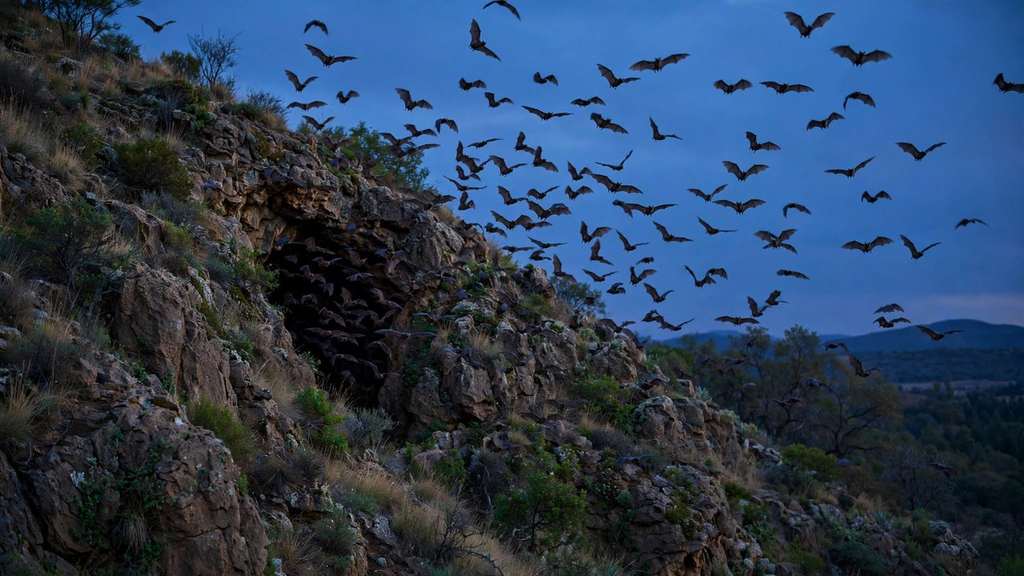
The world's bats split broadly into two camps. The large fruit bats, often called megabats or flying foxes, have big eyes and strong vision. Most of them do not echolocate at all. They find fruit and flowers with their eyes and their sense of smell, flying at dusk when there is still light to use.
The smaller insect hunting bats lean harder on sound. Their eyes are smaller, but they work. Science News Explores, the youth edition of Science News, explains that these bats use echoes to build a picture of their surroundings and can even solve problems that once looked impossible for sound alone. In experiments led by Inga Geipel of the Smithsonian Tropical Research Institute, bats found still insects sitting on leaves, a target scientists thought would be hidden by the leaf's own echo. The bats approached at an angle, so the leaf reflected most of the sound away like a mirror, and the weak echo from the insect stood out.
Eyes tuned for the dark
Bat eyes are built for low light. Britannica notes that bat eyesight is attuned to dim conditions and that bats need less light than humans to see clearly. Vision also covers what sound cannot. Echolocation reaches only a short distance ahead, so a bat crossing open country uses its eyes for the far view, landmarks, and the route home, the same way a driver uses headlights for the road close by and eyes for everything else.
Even the flight style that looks erratic to us is evidence of working senses stacked together. A bat chasing a moth is steering by echo, sight, and memory at once, updating all three many times a second.
Why the myth refuses to die
The phrase is catchy, bats are active when human vision is at its worst, and their most famous sense is invisible and mostly inaudible to us. Put together, a wrong idea felt obvious for centuries. It also flatters us a little: the animal that owns the night must be missing the sense we rely on most.
The truth is better. Bats did not trade sight for sound. They kept both, tuned each for the dark, and switch between them as the hunt demands. Blind as a bat should really mean sharp in two senses at once.