
Shuffle a Deck Well and You Are Probably Holding an Order That Has Never Existed Before
A 52 card deck can be arranged in more ways than there are atoms on Earth. The exact count runs to 68 digits, and the honest math is stranger than the viral version.
Key points
- Every thorough shuffle of a deck of cards probably creates something new in the history of the world: an order of 52 cards that has never existed before and will likely never exist again.
- The claim survives the math, but only in its honest form.
- Arranging cards is multiplication.
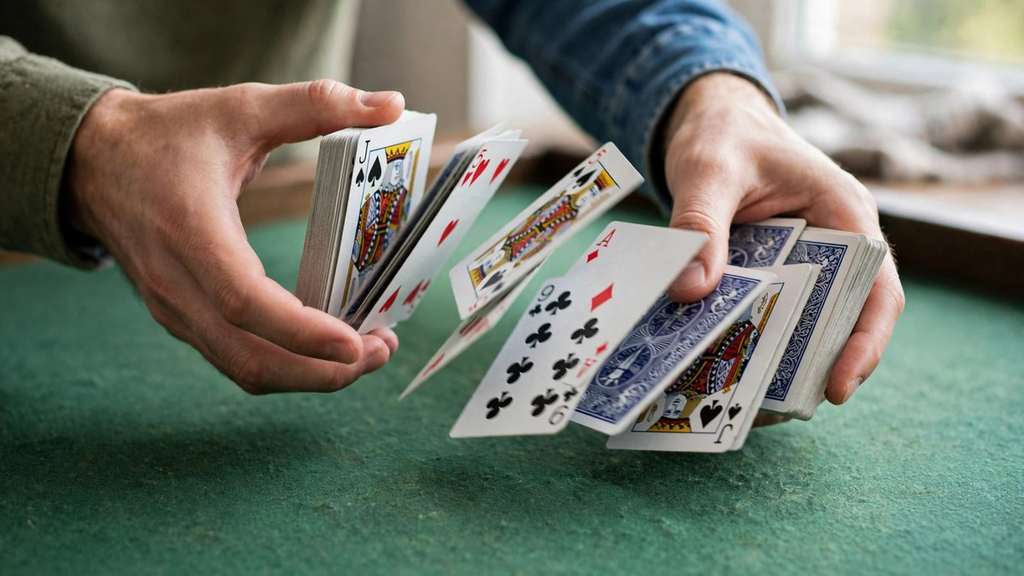
Every thorough shuffle of a deck of cards probably creates something new in the history of the world: an order of 52 cards that has never existed before and will likely never exist again. That sounds like a party trick exaggeration. It is arithmetic.
The claim survives the math, but only in its honest form. The popular version says a deck has more arrangements than there are atoms in the universe. That part is wrong, and correcting it makes the real number more impressive, not less.
The number behind a shuffle
Arranging cards is multiplication. The top card of a shuffled deck can be any of 52 cards. The next can be any of the 51 left, then 50, and so on down to 1. Multiply it all and you get 52 factorial, written 52!, which equals 80,658,175,170,943,878,571,660,636,856,403,766,975,289,505,440,883,277,824,000,000,000,000. That is about 8.07 x 10^67, a number with 68 digits, as the McGill Office for Science and Society explains in its breakdown of the calculation.
Small decks show why the total explodes. Ten cards make 3,628,800 orders, already more than three million. Twenty cards make about 2.4 x 10^18 orders, past two quintillion. By 52 cards the count has left ordinary language behind.
Bigger than Earth, smaller than the universe
Scientists estimate Earth holds about 10^50 atoms. The deck count beats that by a factor of roughly a billion billion. But the observable universe holds something like 10^78 to 10^80 atoms, which beats the deck count easily. The viral claim overshoots. The true claim is the one worth repeating: more orders in a handheld deck than atoms in the entire planet you are standing on.
Time makes the point sharper. Imagine every person on Earth shuffling one deck per second, nonstop, since the Big Bang about 13.8 billion years ago. The total shuffles would come to roughly 10^27. Against 10^67 possible orders, that is not a dent. It is not even a trillionth of a trillionth of a trillionth of the total. Card games have been played for centuries across the whole world, and the fraction of possible orders ever produced is so small it rounds to zero.
Why seven shuffles matter
There is one catch. A lazy shuffle does not reach the deep end of that number space. Decks fresh from the box start in a standard order, and card games push cards into familiar patterns. Mathematicians studying riffle shuffles found that about seven thorough riffle shuffles make a deck effectively random, meaning every order becomes about equally likely. Fewer shuffles leave traces of the starting order. More add little.
So the ritual at the card table is doing real work. One or two casual shuffles and you are rearranging history. Seven good ones and you are most likely holding a sequence of 52 cards that no game, casino, or kitchen table has ever produced. Shuffle again and you will almost certainly do it again. The deck in your hands is ordinary cardboard. The number hiding inside it is not.