
Cleaner Milk Nearly Killed the Holes in Swiss Cheese. Hay Dust Saved Them.
The holes in Emmental come from gas made by bacteria, but the bubbles need a starting point. For centuries that starting point was microscopic hay dust falling into open milk buckets.
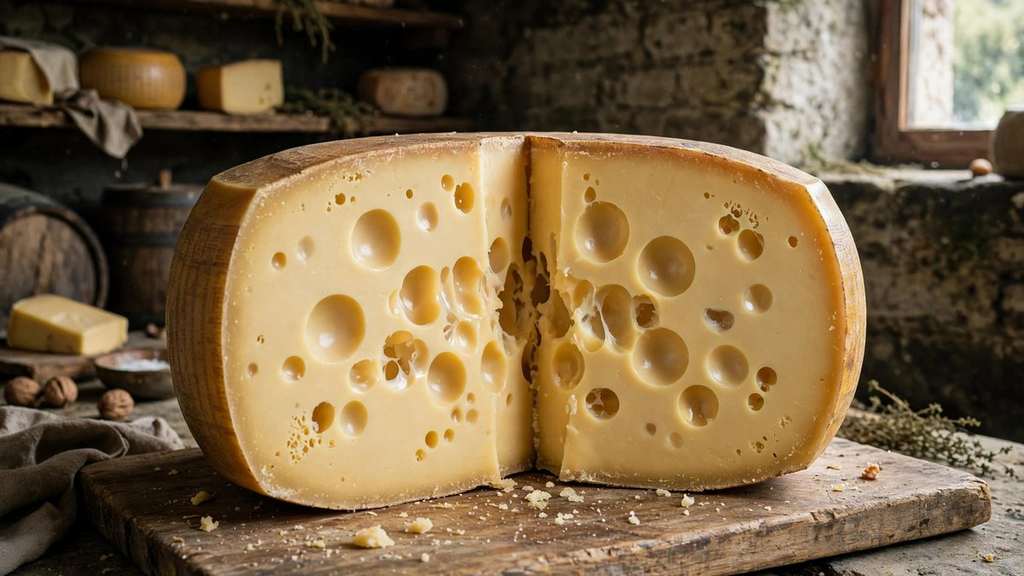
Key points
- The holes in Swiss cheese are not made by mice, drills, or clever marketing.
- Cheesemakers call the holes eyes.
- The basic chemistry has been settled since 1917, when American chemist William Clark published a detailed study blaming carbon dioxide released by bacteria in the cheese.
The holes in Swiss cheese are not made by mice, drills, or clever marketing. They are bubbles, and for about a century scientists thought they understood them completely. Then the holes started disappearing, and the real answer turned out to involve hay.
Cheesemakers call the holes eyes. A wheel of Emmental with no eyes is called blind, and blind cheese is a problem when the holes are the reason customers buy it.
Gas makes the bubble
The basic chemistry has been settled since 1917, when American chemist William Clark published a detailed study blaming carbon dioxide released by bacteria in the cheese. The bacteria involved, Propionibacterium, feed on lactic acid inside the aging wheel and give off carbon dioxide gas. The gas gathers into pockets, and the pockets become the eyes when the wheel is cut. The same bacteria help produce propionic acid, which gives Emmental part of its sweet, nutty flavour. The eyes grow while the wheels rest in warm aging rooms, over months of ripening.
So far, so simple. Bacteria make gas, gas makes holes. What the simple story could not explain was why the holes were shrinking.
Then the holes started vanishing
In the years before 2015, Swiss cheese graders and farmers noticed that Emmental wheels had fewer and smaller eyes than they used to, and some wheels came out blind. The bacteria had not changed. The recipes had not changed. Something in the milk had changed.
Researchers at Agroscope, the Swiss federal centre for agricultural research, found the missing piece in 2015. Traditional Swiss milking was done by hand, into open buckets, in barns full of hay. Microscopic particles of hay dust fell into the milk. Those tiny particles, only a few thousandths of a millimetre wide, sat inside the curd and gave the carbon dioxide a weak point to gather around. A bubble needs a seed, and hay dust was the seed.
Modern milking removed the seed. Sealed milking machines and cleaner barns kept the hay out, and as the milk got cleaner over the previous 10 to 15 years, the eyes got scarcer. Agroscope tested the idea directly by adding measured amounts of hay powder to purified milk. More hay particles meant more holes. The dose controlled the result.
The fix is a pinch of the old dirt
The finding flipped a century of assumptions. The holes were never just about bacteria. They were about bacteria plus a trace of the old barn. Cheesemakers who want the classic look can now restore it on purpose, adding a controlled amount of hay derived powder to the milk so the bubbles form the way they did when buckets sat open under the hayloft.
There is a pleasing lesson in it. Food science spent decades making milk cleaner, and the cleaner milk quietly broke a food whose identity depended on a speck of contamination. The holes in Swiss cheese are a fossil of an older farm, preserved in every slice: part chemistry, part hay dust, part accident that people learned to love and then had to learn to recreate.