
The Largest Living Thing on Earth Is a Fungus Hiding Under an Oregon Forest
One honey fungus in the Malheur National Forest covers 2,385 acres, may weigh 35,000 tons, and could be more than 8,000 years old. Almost all of it is underground.
Key points
- The largest known living organism on Earth is not a whale and not a tree.
- The organism is a honey fungus, Armillaria ostoyae, growing in the Malheur National Forest.
- Forest workers first investigated the infestation in 1988, when Greg Whipple of the US Forest Service began mapping patches of dying grand fir.
The largest known living organism on Earth is not a whale and not a tree. It is a fungus, and it spends its life underground in the Blue Mountains of eastern Oregon.
The organism is a honey fungus, Armillaria ostoyae, growing in the Malheur National Forest. Genetic testing showed that samples collected across 965 hectares, about 2,385 acres, all belong to one single individual. Guinness World Records lists it as the largest known fungus, and its estimated weight runs from 7,500 to 35,000 US tons.
Found by following dead trees
Forest workers first investigated the infestation in 1988, when Greg Whipple of the US Forest Service began mapping patches of dying grand fir. At first the fungus looked like separate outbreaks covering about 400 acres. Later genetic research changed the picture. The patches were one connected organism, spreading tree to tree below the soil.
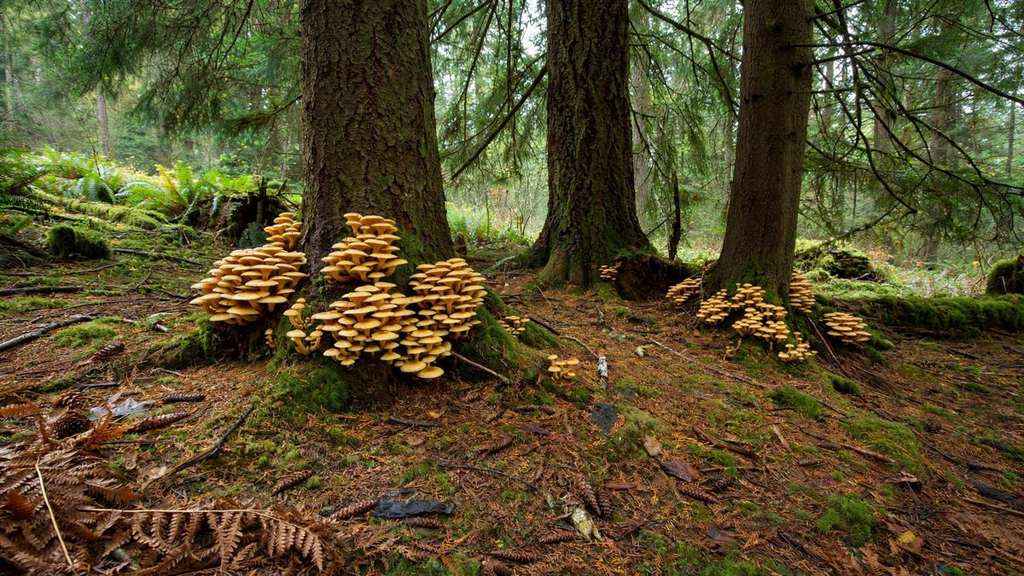
Most of the fungus is hidden. It travels through soil and roots as dark, root-like cords called rhizomorphs, and it grows pale sheets under the bark of infected trees. Guinness notes that most of its tissue sits about a metre underground. The only part most people ever see comes in autumn, when clusters of honey colored mushrooms push up at the base of infected trees for a few weeks.
Old, slow, and patient
By counting backwards from its growth rate, researchers estimate the fungus is at least 2,400 years old and may be as old as 8,650 years. It started long before the Roman Empire, from a single spore, and it has been expanding ever since at a slow underground pace.
It feeds as it grows. The fungus attacks living roots, blocks the flow of water and nutrients, and rots the wood. The Oregon Encyclopedia notes it can take 20 to 50 years for the fungus to kill one tree. After the tree dies, the fungus keeps feeding on the dead wood and uses the stump as a base to reach the next tree.
Why it matters
A single organism this size breaks the usual idea of what one living thing looks like. It has no head, no centre, and no single body you can photograph. You could walk across it for the better part of an hour and never leave it. Foresters also have a practical reason to map it: the same fungus is a serious root disease, and knowing where one giant individual ends helps them understand how the disease moves through a forest.