
North Korea Tests Cluster-Bomb Warhead for Tactical Ballistic Missiles
State media says the Standard Type 2 warhead can devastate 12 to 13 hectares and that four types of cluster warheads will reach military units this year. The figures are Pyongyang's own claims and have not been independently verified.
Key points
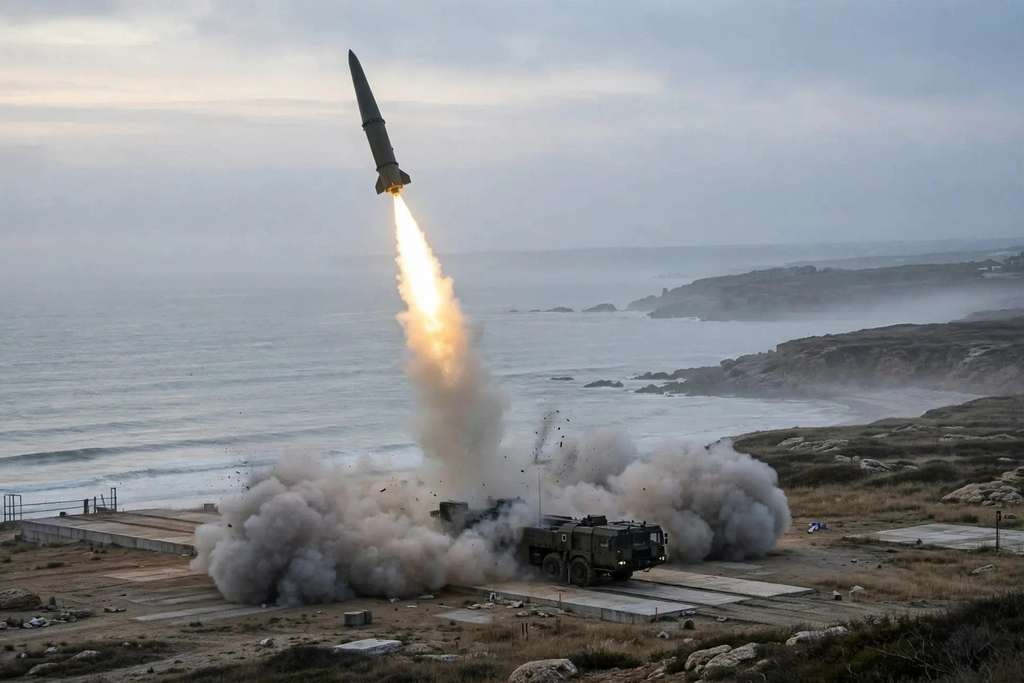
- North Korea has tested a cluster-bomb warhead built for its tactical ballistic missiles and says it will field several types of the warhead before the end of the year, state media reported on Sunday.
- The Korean Central News Agency (KCNA) said the Missile Administration carried out the test on Saturday, October 31, to assess the warhead's adaptation to combat and its power, Reuters reported.
- Research institutes under the Missile Administration said the test confirmed that the Standard Type 2 cluster-bomb warhead can turn a target area of 12 to 13 hectares into ashes at its highest…
North Korea has tested a cluster-bomb warhead built for its tactical ballistic missiles and says it will field several types of the warhead before the end of the year, state media reported on Sunday.
The Korean Central News Agency (KCNA) said the Missile Administration carried out the test on Saturday, October 31, to assess the warhead's adaptation to combat and its power, Reuters reported. General Kim Jong-sik, a member of the Central Military Commission of the ruling Workers' Party of Korea and first vice department director of the party's central committee, oversaw the test, KCNA said. North Korean leader Kim Jong Un was not reported to be present.
What Pyongyang claims the warhead can do
Research institutes under the Missile Administration said the test confirmed that the Standard Type 2 cluster-bomb warhead can turn a target area of 12 to 13 hectares into ashes at its highest density, according to KCNA. Twelve to 13 hectares is roughly 30 to 32 acres. Those figures are North Korea's own claims. No outside party has verified them, and KCNA gave no flight distance, launch time or launch site for the missile.
A cluster warhead carries many smaller submunitions inside one warhead and scatters them in flight, so a single missile can strike targets across a wide area instead of one point.
The general director of the Missile Administration said the country classifies its cluster warheads into four categories by purpose, covering special and standard types. "Within this year we will enable units to select and use all those types according to operational aims and specific features of targets," the director said, according to KCNA.
What South Korea detected
South Korea's Joint Chiefs of Staff said it detected a missile fired on October 31 from around Chongju in North Pyongan Province, in the northwest of the country, toward the Yellow Sea, known in Korea as the West Sea, Yonhap reported. The military said South Korea and the United States had tracked related movements before the launch under close information sharing and had maintained a readiness posture. Seoul did not announce the launch on the day it happened.
KCNA did not name the missile used. Shin Jong-woo, an analyst at the Korea Defense and Security Forum in Seoul, told Yonhap the missile appeared to be from the Hwasong-11 family, the North's line of short-range ballistic missiles. That identification rests on the photographs KCNA released, not on a statement from Pyongyang.
A programme Pyongyang has shown before
The test is not the first of its kind. In April, North Korea said it tested cluster bombs mounted on the Hwasong-11 Ra tactical ballistic missile, in a launch overseen by Kim Jong Un and his daughter Ju-ae, to evaluate the power of a cluster warhead and a fragmentation mine warhead fitted to the system, the Korea JoongAng Daily reported.
Saturday's test also came two days after North Korea fired around 10 short-range ballistic missiles from its east coast toward the sea on Thursday, October 29, a launch carried in this newsroom's earlier coverage. Pyongyang has stepped up missile testing through the autumn, and the Sunday announcement adds a weapon South Korean and allied planners track closely because cluster warheads are built to saturate airfields, ports and troop concentrations rather than hit a single building.
Timeline
- Oct 29, 2026North Korea fires around 10 short-range ballistic missiles from its east coast toward the sea, in a launch covered by this newsroom.
- Oct 31, 2026North Korea's Missile Administration tests a cluster-bomb warhead for tactical ballistic missiles. South Korea's Joint Chiefs of Staff detect a missile fired from around Chongju toward the Yellow Sea.
- Nov 1, 2026KCNA reports the test, says the Standard Type 2 warhead can devastate 12 to 13 hectares, and says four categories of cluster warheads will be available to military units within the year.