
France's Top Court Keeps Central Paris Protest Ban as 70,000 Police Deploy Nationwide
The Conseil d'Etat ruled in the early hours of Saturday that the Paris march must use an outskirts route, as France braces for a third straight weekend of cost of living protests on Halloween.
Key points
- France's highest administrative court, the Conseil d'Etat, ruled in the early hours of Saturday, October 31 to keep a ban on a central Paris protest route, hours before a third straight weekend of…
- The CGT trade union had declared a route between the Bastille and Nation squares in eastern Paris.
- As of Saturday morning, only one Paris march is authorized, on the outskirts of the capital.
France's highest administrative court, the Conseil d'Etat, ruled in the early hours of Saturday, October 31 to keep a ban on a central Paris protest route, hours before a third straight weekend of nationwide demonstrations over living costs, public services and the government of President Emmanuel Macron.
The CGT trade union had declared a route between the Bastille and Nation squares in eastern Paris. The Paris police prefecture did not authorize that route. An administrative court lifted the ban on Friday afternoon, the prefecture appealed, and the Conseil d'Etat ruled in the prefecture's favor in the early hours of Saturday morning, Le Monde reported.
The authorized route
As of Saturday morning, only one Paris march is authorized, on the outskirts of the capital. It runs from Porte de Bagnolet to Porte de Charenton along the Boulevards des Marechaux, with a gathering from noon to 6 p.m. and a departure at 2 p.m., according to the route set by the prefecture. The CGT has called on people to respect the ban. "We never call on people to take prohibited routes. So, under duress, with a heavy heart, we are calling on people to follow the authorized route," Karl Ghazi, a CGT representative, told Agence France-Presse. Le Monde reported that on social media, several people were still saying they intend to rally at Bastille and march to Nation.
A heavy security operation
France has deployed 70,000 police and gendarmes for the day, and the interior ministry said some 150 gatherings were planned across the country, Reuters reported. Interior Minister Laurent Nunez has described the day as carrying a "very high risk" of public disorder and has vowed a firm response. "Everyone is on deck to ensure an extremely firm response to any trouble," Nunez told a news conference earlier this week. A night curfew will be imposed in the Republique and Chatelet-Les Halles neighborhoods from 11 p.m. to 6 a.m. on Saturday and Sunday nights, and more than 1,000 Paris city workers will be mobilized over the weekend to clean up public spaces, the mayor's office said. Authorities are also alert to the risk that rioters could use Halloween masks to hide their identities, and Nunez noted that the law allows police to ban face coverings when public order is at risk. The US Embassy has advised travelers to avoid areas where demonstrations or large gatherings are planned.
Why people are marching
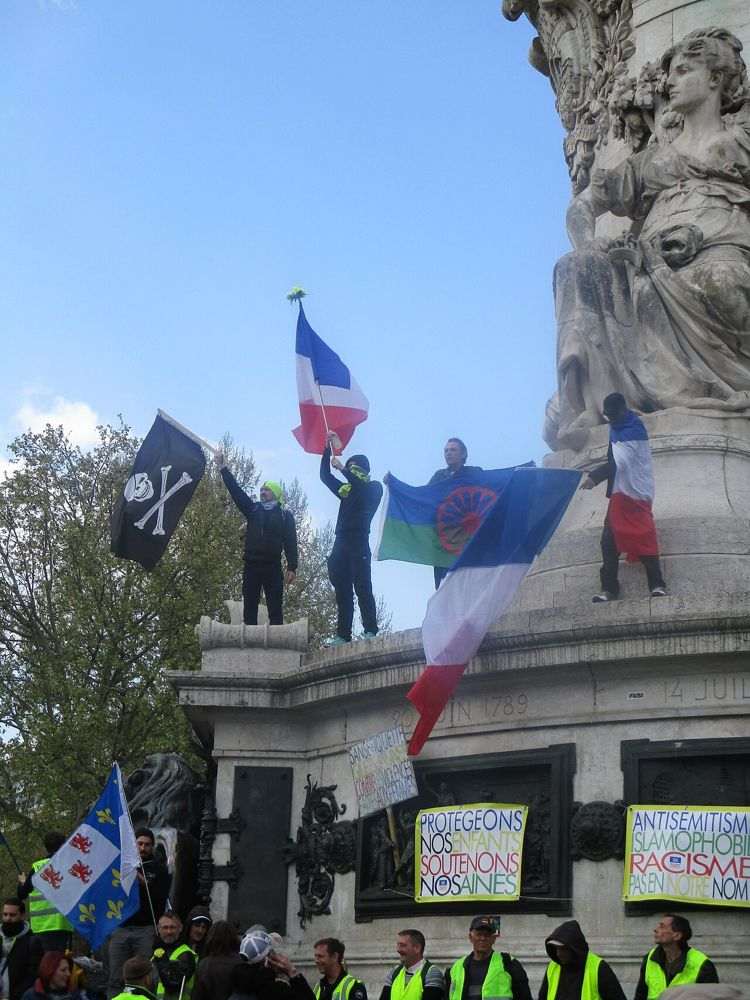
The protests gathered pace in late September as Macron's minority government opened talks on the 2027 budget, with public debt approaching 120 percent of economic output, Reuters reported. Students angry at the state of schools and at a university admissions system many see as unfair have been joined by trade unions and a re-emerging Yellow Vest movement demanding action on the cost of living. Saturday's demonstrations come two weeks after riots and looting damaged shops, public buildings and businesses in cities across France. The Chamber of Commerce estimates that losses to retailers exceed 1 billion euros, about $1.1 billion, and official data on Friday showed the French economy contracted in the third quarter.
Timeline
- Oct 17, 2026Riots and looting during an earlier protest weekend damage shops, public buildings and businesses in cities across France.
- Oct 24, 2026A second weekend of protests takes place; in Paris the Bastille to Nation route is approved by the prefecture and then banned the night before the march.
- Oct 30, 2026A Paris administrative court lifts the prefecture's ban on the Bastille to Nation route on Friday afternoon, and the prefecture appeals.
- Oct 31, 2026The Conseil d'Etat upholds the ban in the early hours of Saturday. The authorized march runs from Porte de Bagnolet to Porte de Charenton, and 70,000 police and gendarmes deploy nationwide.