
This Fish Has a See-Through Head, and Its Eyes Sit Inside It
The barreleye lives 600 to 800 metres down. Its green eyes rotate inside a clear fluid-filled dome, pointing up to hunt and forward to eat.
Key points
- The barreleye fish wears its eyes inside its head.
- The fish, Macropinna microstoma, lives in the deep ocean at depths of about 600 to 800 metres, where sunlight fades toward black.
- Scientists first described the barreleye in 1939.
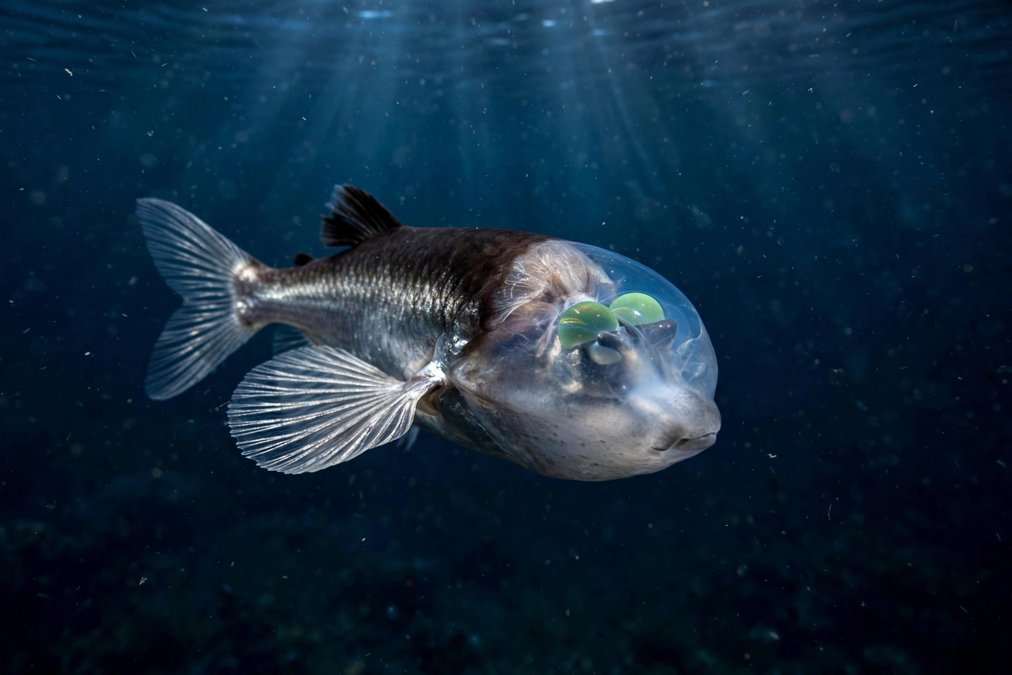
The barreleye fish wears its eyes inside its head. A clear, fluid-filled dome covers the top of the fish, and through it you can see two bright green tubular eyes pointing straight up.
The fish, Macropinna microstoma, lives in the deep ocean at depths of about 600 to 800 metres, where sunlight fades toward black. It grows to only about 15 centimetres, hangs nearly motionless in the water, and watches the surface world above it for silhouettes. Researchers at the Monterey Bay Aquarium Research Institute, MBARI, solved the long standing puzzle of how this strange head actually works.
A mystery that lasted from 1939
Scientists first described the barreleye in 1939. For decades they knew its tubular eyes collected light well, but the eyes looked fixed in place, locked into tunnel vision aimed only upward. That made little sense for feeding. A fish that can only look up cannot see the food in front of its own mouth.
The other problem was the dome itself. Specimens hauled up in nets arrived damaged, and the delicate transparent shield did not survive the trip. Drawings of the fish left it out. The species was known for half a century without its most distinctive feature.
Robots saw what nets destroyed
MBARI researchers Bruce Robison and Kim Reisenbichler used remotely operated vehicles to film living barreleyes at depth and study one brought up alive. Their paper showed the eyes are not fixed at all. They rotate inside the transparent shield, like binoculars on a swivel. The eyes point up while the fish searches for prey overhead, then swing forward when the fish turns to feed.
The green caps on the eyes may help filter sunlight from above so the fish can pick out the faint glow of jellies and other animals overhead. The two dark spots that look like eyes above its mouth are not eyes at all. They are nares, smell organs, the fish version of nostrils.
The rest of the body fits the same patient strategy. Large flat fins let the barreleye hold almost perfectly still and maneuver with precision. Its mouth is small and selective, its stomach large, and stomachs of net-caught fish held fragments of jellies. Robison's working theory: the fish waits under jelly-like animals, watches for small prey caught or drifting nearby, rotates its eyes forward, and rises to take it.
Why it matters
The barreleye is a reminder of how much deep sea biology was built on damaged evidence. The animal made sense only when scientists watched it alive, in its own dark water, with its head intact. The clear dome likely protects those valuable eyes from the stinging cells of the jellies it hunts around. Evolution did not give this fish a window for looks. It gave it a shielded lookout tower.