
Antarctica Has a Red Waterfall. The Color Is Rust, Not Blood.
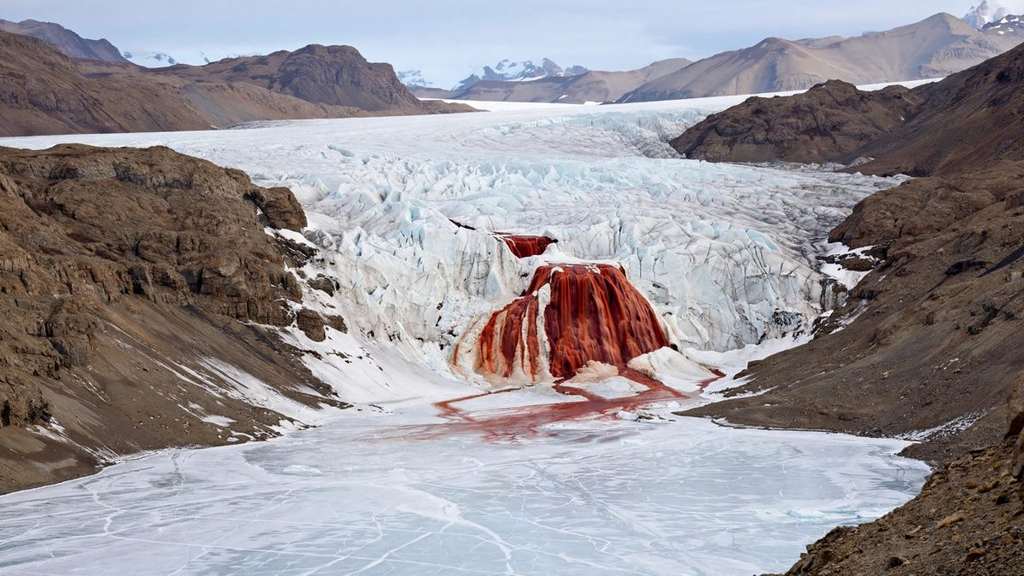
Blood Falls spills bright red water from the Taylor Glacier. The water sat sealed under the ice for at least a million years, loaded with iron and salt, and it rusts the moment it meets air.
Key points
- A waterfall in Antarctica runs bright red, and it pours out of a white glacier into a frozen lake.
- The place is Blood Falls, at the end of the Taylor Glacier in the McMurdo Dry Valleys of East Antarctica.
- The water that feeds the falls does not come from melting surface ice.
A waterfall in Antarctica runs bright red, and it pours out of a white glacier into a frozen lake. It looks like the ice is bleeding. No blood is involved.
The place is Blood Falls, at the end of the Taylor Glacier in the McMurdo Dry Valleys of East Antarctica. Geologist Thomas Griffith Taylor found it in 1911, during an early Antarctic expedition. Taylor and his team first blamed red algae for the color. That guess was wrong.
Water sealed away for a million years
The water that feeds the falls does not come from melting surface ice. Smithsonian Magazine reports that it comes from a salty lake trapped under about 400 meters of ice. Sea water flooded the valley millions of years ago and formed the lake. Glaciers later covered it and cut it off from the sea, from sunlight, and from the air.
Cut off from fresh water, the lake grew saltier as the ice above it froze. Smithsonian describes the brine today as about three times saltier than sea water, salty enough that it does not freeze even in Antarctic cold. The lake also holds a lot of iron, scraped from the bedrock below as glaciers ground across it.
Why it turns red at the surface
The brine stays hidden until pressure pushes it through cracks in the glacier. Then, for the first time in a very long time, the iron rich water meets oxygen in the open air. The iron reacts with that oxygen and forms iron oxide. That is rust, the same chemistry that turns an old nail red brown.
A 2017 study in the Journal of Glaciology, reported by Smithsonian Magazine, mapped the hidden path of the brine with radio echo sounding. Radio waves bounced back at different speeds from ice and from liquid water, which let the team trace a reservoir under the glacier and a path about 90 meters long to the falls. The study also explained how liquid water can survive under a cold glacier: salt lowers the freezing point, and water releases heat as it freezes, which warms the ice around it.
Life with no light and no oxygen
The sealed lake is not empty. Science News Explores, published by the Society for Science, notes that microbes live in the brine with no sunlight and almost no oxygen. They draw energy from sulfates, sulfur compounds in the water, and their chemistry recycles iron in the brine. A community that lives this way is a useful model for researchers who ask how life could survive in salty water hidden under ice on other worlds, such as Mars or the icy moons of Jupiter.
Blood Falls is five stories tall, and it flows only now and then, when cracks open and pressure sends the brine out. Each flow paints a fresh red stain on the Taylor Glacier. The color is dramatic, but the cause is plain chemistry: old sea water, iron, salt, and a first breath of air after at least a million years underground.