
Nearly 200 Countries Adopt Nature Agreements at COP17 in Yerevan
Delegates in Yerevan adopted a set of agreements on Friday after talks ran into overtime. The central review, called the Yerevan Pathway, urges faster action to stop nature loss, but the final texts were not immediately available.
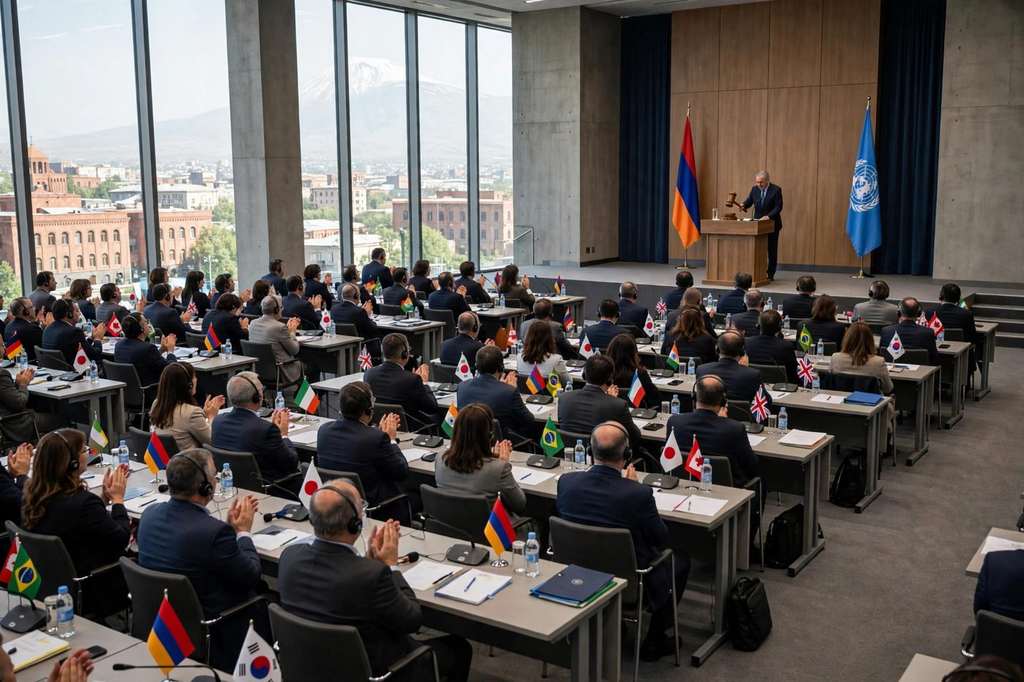
Key points
- Nearly 200 countries adopted a set of agreements at the UN biodiversity conference COP17 in Yerevan, Armenia, on Friday, October 30, 2026, after negotiations ran into overtime past the scheduled…
- The final versions were not immediately available, and the agreed global review had still not been published hours after its adoption, so reports describe what was adopted, not the exact final…
- The agreements seek to renew efforts to stop nature loss by 2030 under the 2022 Kunming-Montreal framework.
Nearly 200 countries adopted a set of agreements at the UN biodiversity conference COP17 in Yerevan, Armenia, on Friday, October 30, 2026, after negotiations ran into overtime past the scheduled close. Delegates cheered as the texts were approved, and COP17 president Hambardzum Matevosyan brought down the gavel. "And that is it. Perfect," he said.
The final versions were not immediately available, and the agreed global review had still not been published hours after its adoption, so reports describe what was adopted, not the exact final wording.
The Yerevan Pathway
The agreements seek to renew efforts to stop nature loss by 2030 under the 2022 Kunming-Montreal framework. COP17 was the first global review of progress under that framework, which contains 23 targets.
The central review decision is called the Yerevan Pathway. A WWF account said it acknowledges insufficient progress and gives guidance to accelerate action, including on finance and harmful subsidies. It is not a replacement for the 2022 framework and sets no new enforceable quotas.
According to the United Nations, progress has lagged and key targets are off track, including protecting 30 percent of land and oceans by 2030, tackling pollution, and increasing money for conservation. A draft urged nations to accelerate and warned that more action was needed against the forces driving loss. It was not clear which recommendations made the final text.
Money stayed the hardest fight
Negotiations were contentious over conservation funding and over reform of subsidies that encourage activities harmful to nature, such as fossil fuels, intensive agriculture and overfishing. An estimated 2.4 trillion dollars still flows every year to harmful subsidies.
The 2022 framework commits countries to cut harmful subsidies by at least 500 billion dollars by 2030, and to mobilise 200 billion dollars a year for biodiversity by 2030, including 30 billion dollars a year in international finance for developing countries. The finance gap is estimated at 700 billion dollars a year.
More than 1.8 billion dollars in new funding had been announced by the end of the high level segment, below the annual target. WWF said governments agreed criteria for a future permanent finance mechanism and a review of two existing channels. The European Union pushed wealthy emerging economies such as China to contribute voluntarily.
The Cali Fund, a UN mechanism for sharing profits from firms that use genetic data from plants and other organisms, set out to raise 1 billion dollars a year in early 2025 and has so far attracted around 10,000 dollars.
Praise, with clear reservations
Catherine Weller of Fauna and Flora said that "while not particularly exciting or detailed, it is good news that countries could reach agreement." Kirsty Leong of WWF International called it a good outcome on balance, with strengths and weaknesses. An unnamed negotiator from a developed country called it "glacial progress." Alfred DeGemmis of the Wildlife Conservation Society said the obstructionist politics of the climate talks have entered the biodiversity negotiations.
After the main texts were approved, talks on other items dragged into the early hours of Saturday, October 31, and the tone soured. Around 70 ministers had joined in the final week.
Early on Saturday, COP17 decided Ecuador will host COP18 in 2028, after defeating Panama in a secret vote. At the previous summit in Colombia in 2024, talks ran overtime and ended without a finance deal. They resumed in Rome in 2025, where an agreement was reached.
Timeline
- 2024The previous biodiversity summit in Colombia ran overtime and ended without a deal on finance. Negotiations resumed in Rome in 2025, where an agreement was reached.
- Oct 30, 2026Nearly 200 countries adopted a set of agreements at COP17 in Yerevan after negotiations ran into overtime, and delegates cheered as the texts were approved.
- Oct 31, 2026COP17 decided early Saturday that Ecuador will host the next UN biodiversity talks, COP18, in 2028, after defeating Panama in a secret vote.