
Israel Election Tuesday: Netanyahu vs Eisenkot, What to Know
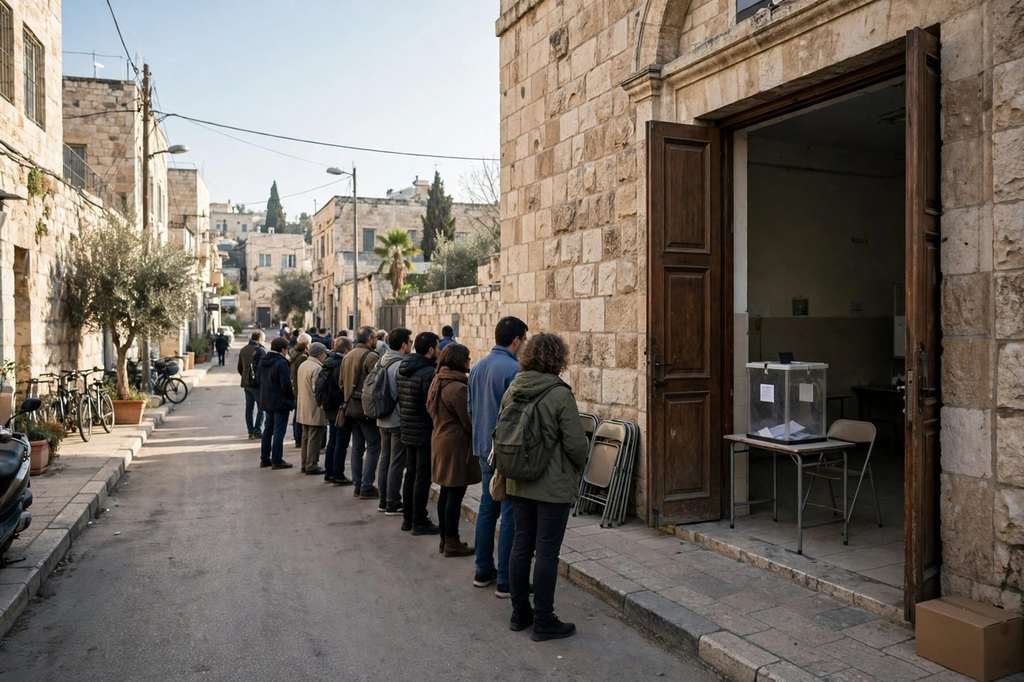
Polls open at 7 a.m. and close at 10 p.m. on Tuesday for the 120 seat Knesset. A government needs 61 seats, final polls put Eisenkot's Yashar just ahead of Netanyahu's Likud, and neither bloc is close to a majority on its own.
Key points
- Updated 21:58 UTC, Oct. 28, 2026.
- Yousef Jabareen, the chairman of the Joint List, told Israel's Channel 13: "Anyone who wants to offer a substantive and genuine alternative to Netanyahu's government of bloodshed will have to talk…
- Updated 17:38 UTC, Oct. 28, 2026.
Update: Count passes 97 percent, Netanyahu bloc at 53 seats and Arab parties at 19
Updated 21:58 UTC, Oct. 28, 2026. With 97.63 percent of ballots counted at 11:35 p.m. local time, the Central Elections Committee count reported by The Petek gives Prime Minister Benjamin Netanyahu's bloc 53 seats, the Change bloc led by Gadi Eisenkot 48 seats and the Arab-led parties 19 seats in the 120-seat Knesset. The count covered 5,102,165 valid votes at 11,712 polling stations. Votendi's provisional seat calculation from the committee figures puts Likud first with 26 seats and Eisenkot's Yashar second with 21, with the Joint List at 12 seats and Ra'am at 7, giving the Arab-led parties their combined 19. Neither bloc is near the 61 seats needed to govern. Reuters reported that Netanyahu pulled ahead as votes were counted on Wednesday but that the loss of a parliamentary majority leaves his path to another term dependent on drawing rivals into a coalition. The remaining double-envelope ballots, cast by soldiers and other special voters, are counted on October 29, and official results are expected on November 4.
Yousef Jabareen, the chairman of the Joint List, told Israel's Channel 13: "Anyone who wants to offer a substantive and genuine alternative to Netanyahu's government of bloodshed will have to talk to us in order to pave the way for the change that the Israeli public longs for," The Times reported.
Update: Count passes 84 percent, Eisenkot bloc climbs to 49 seats
Updated 17:38 UTC, Oct. 28, 2026. With 84.5 percent of the vote counted, the Central Elections Committee figures reported on Wednesday afternoon give Prime Minister Benjamin Netanyahu's bloc 54 seats, the bloc led by Gadi Eisenkot 49 seats and the Arab-led parties, the Joint List and Ra'am, 17 seats in the 120-seat Knesset, the Washington Examiner reported. Likud remains the largest single party with 27 seats and Eisenkot's Yashar holds 22. Neither bloc is close to the 61 seats needed to govern. Most of the ballots still to count are double envelopes cast by soldiers, reservists, diplomats, hospital patients and displaced Israelis, and about 600,000 of those votes could still move the margin. Netanyahu repeated that a strong, national, right-wing government must be formed. Eisenkot said the prime minister had lost public support and urged him to retire from politics, Reuters reported. Netanyahu stays in office as caretaker while coalition talks run, or until a new election in 2027.
Update: Shekel and stocks fall as the count passes 70 percent
Updated 12:45 UTC, Oct. 28, 2026. Israel's financial markets fell on Wednesday as counting continued. With about 71 percent of votes tallied, Israeli media projected Netanyahu's bloc at 54 seats, the Eisenkot opposition bloc at 47 and the Arab parties at 19, Reuters reported. The shekel weakened about 2 percent to 3.1185 to the dollar, on track for its worst day in 16 months, and Tel Aviv's benchmark TA-125 index fell about 3 percent. William Jackson of Capital Economics said the early results offered more paths for Netanyahu to remain in power, though any government that emerged was unlikely to be robust. Definitive results were expected on Thursday, Oct. 29, 2026.
Update: Count reaches 72.5 percent, Netanyahu bloc projected at 54 seats and opposition at 48
Updated 08:59 UTC, Oct. 28, 2026. Israel's Central Elections Committee had counted 3,775,461 votes at 8,702 polling stations as of 10:01 a.m. on Wednesday, about 72.5 percent of ballots, and projections from that count put Prime Minister Benjamin Netanyahu's bloc at 54 seats, Gadi Eisenkot's opposition bloc at 48 and the Arab parties at 18, the New York Post reported, citing the committee figures published by Israeli media. Likud led the party vote with 790,994 votes, 21.05 percent, which projects to 27 seats. Yashar followed with 606,897 votes, 16.24 percent, projecting to 21 seats. The Joint List projects to 12 seats and B'Yachad to 11, with the Democrats and Yisrael Beiteinu at eight each, United Torah Judaism, Shas and Otzma Yehudit at seven each, and Religious Zionism Zehut and Ra'am at six each. Neither main bloc is close to the 61 seats needed for a majority in the 120 seat Knesset, and the projections remain subject to change as the count continues. If the partial result holds, Netanyahu would be in a strong position to receive the first chance to form the next government, the Post said.
Update: Partial count puts Netanyahu bloc ahead 57 seats to 47, with 37 percent of votes counted
Updated 06:20 UTC, Oct. 28, 2026. The official count has moved the picture away from the tied exit polls. With about 37 percent of votes counted, just over two million ballots, figures from Israel's Central Elections Committee reported by The Times put Prime Minister Benjamin Netanyahu's Likud projected at 28 seats, with Gadi Eisenkot's Yashar at 21 seats. Harava reported partial results covering about 42 percent of ballots that put Netanyahu's bloc ahead with a projected 57 seats to the opposition bloc's 47, with Arab led parties projected at 16 seats. Channel 12, reported by The Times, said Netanyahu's bloc steadily gained ground throughout the night.
Both blocs remain short of the 61 seats needed for a majority in the 120 seat Knesset, and the numbers are projections from a partial count, not a final result. The Times said a final result may wait until late Wednesday or even Thursday morning. President Donald Trump, speaking to reporters aboard Air Force One on Wednesday, claimed his endorsement of Netanyahu had helped him. "I think when the endorsement went out, it had helped him a lot," Trump said, according to The Times.
Update: Updated exit polls tie the blocs at 51 seats each, final turnout confirmed at 77.7 percent
Updated 01:56 UTC, Oct. 28, 2026. Israel's Central Elections Committee put final turnout at 77.7 percent of eligible voters, the highest figure since 1999 and up from 70.6 percent in the 2022 election, Xinhua and NPR reported. Updated exit polls published overnight narrowed the race further. Kan 11 and Channel 13 put the blocs led by Prime Minister Benjamin Netanyahu and by Gadi Eisenkot level at 51 seats each, and a revised Channel 12 poll put Netanyahu's bloc slightly ahead at 52 seats, reversing the narrow opposition lead in the first polls, Reuters reported in live updates carried by AnewZ, and IANS and The Times reported the same revised figures. The Wall Street Journal reported that one Channel 12 projection had Netanyahu's allies as high as 53 seats. Every updated poll still left both blocs short of the 61 seats needed to form a government in the 120 seat Knesset, with Arab parties projected at 16 to 18 seats and Likud the largest single party in all of the updated polls, the Jerusalem Post reported.
The official count is under way, with about 2.5 percent of ballots counted in the first returns reported by the Central Elections Committee, AnewZ reported. Netanyahu addressed supporters in Jerusalem at 3:15 a.m. local time and said Likud was the largest party and that a strong right wing government must be formed, The Times reported. Eisenkot had said earlier in the night that if the first exit polls were the final results, they would mark a victory, the New York Post reported, and opposition leader Yair Lapid said Netanyahu's bloc had suffered a tough defeat. Exit polls are projections and the seat totals have already moved once overnight, so the count, not the polls, will decide which bloc President Isaac Herzog asks first to try to form a government.
Update: Exit polls put Likud first at 25 seats but Netanyahu's bloc falls to 50, short of a majority
Updated 20:29 UTC, Oct. 27, 2026. Exit polls published after voting ended at 10 p.m. local time put Prime Minister Benjamin Netanyahu's Likud as the largest party with 25 seats in the 120 seat Knesset, down from the 32 seats it holds now, according to the Kan 11 exit poll reported by the New York Post and Fox News. Gadi Eisenkot's Yashar party was projected at 23 seats in the Channel 12 and Channel 13 exit polls and 21 seats in the Kan 11 poll, Fox News reported.
The projected bloc totals left neither side able to form a government on its own. Netanyahu's right wing and religious bloc was projected at 50 seats and the main opposition parties at 53 seats, with Arab parties projected at 17 seats, Fox News reported. A government needs 61 seats. The opposition parties and the Arab factions would hold 70 seats combined, although that does not mean they would agree to form a government together. Exit polls are projections, not an official count, and the tally can change as ballots are counted in the coming days. President Isaac Herzog will consult the parties after the certified results and choose the lawmaker he believes has the strongest chance of forming a government, who then has 28 days to negotiate a coalition, with a possible 14 day extension. Official results are scheduled to be published by Nov. 4, and Netanyahu's government stays in power until a new government takes office.
Update: Turnout reaches 66.7 percent by 6 p.m. and the elections committee refuses to extend voting hours
Updated 19:25 UTC, Oct. 27, 2026. Voter turnout reached 66.7 percent by 6 p.m. local time, the Central Elections Committee said, a record for that point in the day and well above the 57.7 percent recorded at the same hour in the 2022 election, IANS reported. More than 4.8 million people had voted by that time, the committee's acting director general, Dean Livne, said.
Prime Minister Benjamin Netanyahu's Likud party, joined by Shas and Otzma Yehudit, asked the Central Elections Committee to extend voting beyond the scheduled 10 p.m. close, citing long queues and heavy congestion at polling stations and rainy weather. Gadi Eisenkot's Yashar party opposed the request, arguing that no exceptional incident had occurred to justify changing the voting schedule and accusing the governing camp of creating grounds to challenge the election's integrity, a claim disputed by Netanyahu's allies. The Central Elections Committee refused the request and decided not to extend voting hours, France 24, The Guardian and Der Spiegel reported. Voters who arrive at a polling station by the 10 p.m. closing time can still cast a ballot while they remain in line. Polls close at 10 p.m. local time, when exit polls are expected. Turnout is not a result, and no winner can be called from participation figures alone.
Update: Turnout reaches 55.7 percent by 4 p.m., the fastest pace on record
Updated 17:53 UTC, Oct. 27, 2026. Voter turnout reached 55.7 percent by 4 p.m. local time, the Central Elections Committee said, up from 47.5 percent at the same hour in 2022 and the highest turnout recorded at that hour since hourly figures began in 1973, Reuters reported. More than four million people had voted by 4 p.m., The Media Line reported. Turnout in Arab and Bedouin communities was also high, at about 61 percent in Rahat and Kafr Qassem, about 63 percent in Lakiya and about 58 percent in Kuseife by 4 p.m., The Media Line reported. Election officials issued instructions to speed up long lines, including checking the identification of the next voter while the previous voter cast a ballot, and said expired identification could be accepted when the photograph clearly established identity.
Prime Minister Benjamin Netanyahu warned supporters about the surge in Arab voting, saying in a post quoted by Reuters: "If we don't wake up now, we'll find ourselves with a government of Mansour Abbas and Ahmed Tibi." Reuters reported that cars flying Likud flags drove through Jerusalem blaring the Islamic call to prayer and urging supporters to vote because "Arabs are voting", according to witnesses. Arab leaders denounced the tactic as racist. Ahmed Tibi said strong turnout among Israel's Arab minority would "pave the way for an alternative government and change the grave reality", Reuters reported. Sami Abu Shehadeh, leader of the Balad party, wrote that long lines outside polling stations should bring "pride and joy to anyone who believed in democracy". Polls close at 10 p.m. local time, when exit polls are expected. Turnout is not a result, and no winner can be called from participation figures alone.
Update: Turnout reaches 44.9 percent by 2 p.m., the highest at that hour since 1973
Updated 14:48 UTC, Oct. 27, 2026. Voter turnout in Israel's election reached 44.9 percent by 2 p.m. local time, the Central Elections Committee said, up from 38.9 percent at the same hour in the 2022 election and the highest turnout at that hour since 1973, LaPresse reported. At least three million voters had cast ballots by 2 p.m. At noon, turnout stood at 31.5 percent, with more than 2.3 million ballots cast in the first five hours, the fastest pace since the 1977 election, Reuters reported. Israel's shekel rose nearly 1 percent to 3.05 per dollar, a three-week high, as the high turnout was reported, Reuters said. Polls close at 10 p.m. local time. Turnout is not a result, and no winner can be called from participation figures alone.
Netanyahu told Likud supporters that Ra'am operatives were "trying to steal the election from us" and cited the arrest of three men in the south with envelopes of cash and ballots. Election authorities said the men were arrested near their homes before reaching polling stations, called it an isolated case, and said an investigation was under way. In Tel Aviv, police arrested a Jerusalem resident in his twenties who approached Democrats leader Yair Golan at a rally in Mesila Park with a knife, the Democrats said; police confirmed the arrest and possession of a knife and denied there had been an attempted stabbing. Both claims are allegations on a voting day, not findings.
Update: Voting is under way, polls close at 10 p.m.
Updated 10:30 UTC, Oct. 27, 2026. Voting is under way across Israel in the election for the 26th Knesset, the first national vote since the Hamas attack of October 7, 2023. Polling stations opened at 7 a.m. and close at 10 p.m. Israel time, when television channels will publish exit polls, Reuters reported. Exit polls are not results. Counted ballots from polling stations are expected to start appearing in the early hours, with a clearer picture possible a few hours after polls close if one bloc has a clear path to 61 seats.
The final tally is expected by October 30, and official results are formally published on November 4. After that, President Isaac Herzog will consult party leaders and give one candidate the task of forming a government. That candidate has up to 42 days to build a coalition. About a dozen parties have a chance of clearing the 3.25 percent threshold, so small party results will decide who can reach 61 seats in the 120 seat Knesset.
Israelis vote on Tuesday, October 27, 2026, for the 26th Knesset, the country's parliament. It is the first general election since the Hamas attack of October 7, 2023 and the wars that followed in Gaza, Lebanon and Iran. Prime Minister Benjamin Netanyahu, in office for 19 years across his terms and the longest serving leader in Israel's history, is seeking another term while standing trial on corruption charges. The challenger leading the opposition side is Gadi Eisenkot, a former military chief of staff whose party is called Yashar.
How the vote works
About 7.3 million people aged 18 and above are eligible to vote, according to Israel's Central Elections Committee. Most polling stations open at 7 a.m. and close at 10 p.m., and anyone still in line at closing time can vote. Election day is a national holiday. Voters choose a party list, not a person. The Knesset has 120 seats and a government needs 61. No party has ever won 61 seats on its own, so every Israeli government is a coalition. A list needs 3.25 percent of the valid vote to enter parliament at all. Thirty eight lists qualified for this election. After the vote, parties have 28 days to build a coalition, with a possible extension of up to 14 days. If no one reaches 61, the country votes again.
What the final polls say
Final polls published on October 23 put Yashar at 22 to 23 seats and Netanyahu's Likud at 19 to 21 seats. Poll averages show neither the Netanyahu bloc nor the opposition bloc near 61 seats on its own, with the opposition at about 52 to 56 seats and the Netanyahu bloc at about 50. The other lists include Together, led by Naftali Bennett and Yair Lapid, the Democrats, Yisrael Beytenu, Shas, United Torah Judaism, Religious Zionism-Zehut, Otzma Yehudit, the Joint List and Ra'am. President Donald Trump has endorsed Netanyahu, as Orbit Post reported this week. Israeli polls have a record of missing the final result, so the numbers are a guide to the race, not a forecast.
The issues and what happens next
The campaign has turned on whether there should be a state inquiry into October 7, the conscription of ultra Orthodox men, judicial reform, the cost of living and security in the West Bank, Gaza and toward Iran. Orbit Post reported on October 25 that all West Bank land crossings will close on election day and Palestinian workers are barred from settlements from Sunday. Preliminary results are expected the day after the vote, and official results are expected around November 4. The count on Tuesday night is only the first step. The coalition talks that follow will decide who governs, and they can run for weeks.
Timeline
- Oct 23, 2026Final polls put Yashar at 22 to 23 seats and Likud at 19 to 21 seats, with neither bloc near the 61 seats needed for a majority.
- Oct 25, 2026Israel bars Palestinian workers from West Bank settlements, ahead of closing all West Bank land crossings on election day.
- Oct 27, 2026Israel votes for the 26th Knesset. Most polling stations open at 7 a.m. and close at 10 p.m.
- Oct 27, 2026Turnout reaches 44.9 percent by 2 p.m., the highest at that hour since 1973, after noon turnout of 31.5 percent was the fastest pace since 1977.
- Oct 27, 2026Turnout reaches 55.7 percent by 4 p.m., the highest at that hour since 1973 and up from 47.5 percent in 2022, as Netanyahu warns of a surge in Arab voting and Arab leaders denounce his tactic.
- Oct 27, 2026Turnout reaches 66.7 percent by 6 p.m., a record for that hour, and the Central Elections Committee refuses Likud's request to extend voting past 10 p.m.
- Oct 27, 2026Exit polls after the 10 p.m. close put Likud first with 25 seats, Netanyahu's bloc at 50 seats, the main opposition at 53 and Arab parties at 17, with neither bloc at the 61 seats needed for a majority.
- Nov 4, 2026Official election results are expected around this date, while coalition talks run on a 28 day clock with a possible 14 day extension.
- Oct 30, 2026The final tally is expected by this date. Official results are formally published on November 4, after which President Isaac Herzog consults party leaders on forming a government.
- Oct 28, 2026Final turnout is confirmed at 77.7 percent, the highest since 1999. Updated exit polls tie the blocs at 51 seats each in two surveys, a revised Channel 12 poll puts Netanyahu's bloc at 52 seats, and the official count is under way with both blocs short of 61.
- Oct 28, 2026Partial results with about 37 percent of votes counted put Likud projected at 28 seats and Netanyahu's bloc projected at 57 seats to the opposition's 47, with Arab led parties at 16, still short of the 61 needed for a majority.
- Oct 28, 2026With 72.5 percent of ballots counted, 3,775,461 votes at 8,702 polling stations, projections put Netanyahu's bloc at 54 seats, the opposition at 48 and Arab parties at 18, with Likud first at 27 seats and Yashar at 21, and neither bloc near the 61 needed for a majority.
- Oct 28, 2026With about 71 percent of votes tallied, projections put Netanyahu's bloc at 54 seats, the opposition at 47 and Arab parties at 19, and markets fell: the shekel weakened about 2 percent to 3.1185 to the dollar and the TA-125 index dropped about 3 percent.
- Oct 28, 2026With 84.5 percent of votes counted, Netanyahu's bloc holds 54 seats, Eisenkot's bloc climbs to 49 and the Arab-led parties hold 17, leaving neither bloc at the 61 seats needed to govern.
- Oct 28, 2026With 97.63 percent of ballots counted, 5,102,165 valid votes at 11,712 polling stations, projections put Netanyahu's bloc at 53 seats, the Eisenkot-led Change bloc at 48 and the Arab-led parties at 19, with Likud first at 26 seats and Yashar at 21, and neither bloc at the 61 needed for a majority.
Sources
- Al Jazeera via Bahamas Spectator: Israel's elections 2026 explained in maps and charts
- AIJAC: Fact sheet, the 2026 Israeli election
- Israel Gazette: Israel election 2026 guide, parties, polls, how to vote
- Reuters: Israel's election will be held on October 27, coalition head says
- Reuters: Israel election, what happens after polls close
- Reuters: Live 2026 Israel election results
- Reuters: Israel's shekel jumps to 3-week high amid high election turnout
- LaPresse: Israel, turnout at 2.00 pm stands at 44.9 per cent, the highest figure since 1973
- Israel.com (Times of Israel reporting): Netanyahu warns of long queues in Arab towns, accuses Ra'am of election theft
- Franceinfo via 247 News Bulletins: Netanyahu denounces attempts to steal legislative elections in Israel
- LaPresse (Times of Israel reporting): Man armed with a knife approaches Yair Golan in Tel Aviv, arrested
- Reuters: Netanyahu warns of Arab voter surge in Israel's election; Arab leaders call tactic racist
- The Algemeiner: Israel Election Turnout Hits Highest Level Ever as Netanyahu Fights to Stay in Power
- The Media Line: Israeli Election Turnout Hits Historic High as Netanyahu Alleges Fraud and Violence Mars Voting
- Fana News (Petra): Israeli Election Turnout Reaches 55.7 Percent
- Crossfire Arabia: Central Elections Committee refuses Likud request to extend voting after 10 p.m.
- IANS via Hi India: Netanyahu's Likud seeks extension of voting hours in Israel polls, turnout 66.7 percent by 6 p.m.
- Der Spiegel via Project Push: Likud asks for longer opening of polling stations and fails
- France 24 and The Guardian via DAMMNEWS feed: Netanyahu's bid to extend voting hours denied by Central Elections Committee
- Fox News: Israelis vote in record numbers in first national election since the Oct. 7 Hamas massacre, exit polls show Likud largest but bloc short of a majority
- New York Post: Netanyahu loses seats, trails challenger Gadi Eisenkot in Israel election, exit polls show
- Reuters live: Israel votes in pivotal election as Netanyahu faces main rival Eisenkot
- AnewZ (Reuters live updates): Israel election too close to call as updated exit polls point to deadlock
- Xinhua via People's Daily Online: Israeli election turnout hits 27-year high at 77.7 percent
- The Times: Israel election results, Netanyahu buoyed by shifting polls
- IANS: Israel election, exit polls show no clear winner as Netanyahu and opposition fall short of majority
- Wall Street Journal: Early Israeli exit polls show no clear winner in key election
- Harava: Netanyahu and Eisenkot claim paths to lead after Israel election, partial results 57 to 47
- The Times: Israel election results live, 37 percent of votes counted, Likud projected at 28 seats
- Reuters: Netanyahu, Eisenkot stake rival claims to lead Israel after deadlocked vote
- New York Post: Netanyahu's right-wing bloc ahead of opposition as post-election vote count continues
- The Petek: Israel election results 2026, live seat count from Central Elections Committee count
- Reuters: Israeli stocks fall, shekel weakens as Netanyahu bloc beats election forecasts
- Washington Examiner: Netanyahu and his opponent both spin election as victory as results trickle in
- Reuters Breakingviews: Israel's vote prolongs Middle East instability
- Reuters: Israel's election gives survivor Netanyahu a path to keep power
- Votendi: Israel Election 2026 live results, Knesset seats, provisional calculation from Central Elections Committee figures